

I love-love-love soup. Here’s why: it is comforting, hydrating, easy to digest, versatile, and a great vehicle for vegetables, legumes, herbs and spices. You can eat it hot or cold. You can make a big batch and store it in the fridge or freezer (unless it’s raw, like gazpacho).
You can play around with soups’ textures (smooth or chunky? thick or brothy) and colors (tomato soup with a swirl of heavy cream and a scattering of basil leaves, anyone?). Small “accessories” — like a swirl of tahini dressing (plain or herbed), a sprinkling or microgreens or fresh herbs, a dusting of cheese or crumbled Parmesan crisps — can add much excitement.
Soups make great food for anyone who’s sick or undergoing medical treatments and needs easy-to-digest, yet nourishing fare. For people trying to gain weight — which includes many of my clients — soups can be excellent vehicles for nourishing, high-calorie ingredients like bone broth, cream, butter, cheese, or MCT oil.
Last of all: soups are crazy-easy to prepare; all you need is a largeish pot (or better still, a pressure cooker or Instant Pot) and you’re off. A blender or food processor can be useful, but they are not essential.
Yet — and it’s a big yet — many soups don’t make stand-alone meals. If you’re eating a bowl of soup as an appetizer or sandwich accompaniment, that’s fine. But if you’re having soup as your main meal, it needs to contain enough energy (calories), protein, fat, carbohydrates and fiber to fill you up for a few hours, and many soups don’t do that.
Enter: Zhuzhing
I love the expression “to zhuzh up,” which, according to the Merriam-Webster Dictionary, means adding “a small improvement, adjustment, or addition that completes the overall look, taste, etc. of something.” (It’s pronounced /ZHo͝oZH.)
That’s what we’re doing here. We’re taking a tasty, ready-made soup that’s a little imbalanced nutritionally and we’re zhuzhing it up to turn it into a complete meal.
The soup shown here is Trader Joe’s Yellow Tadka Dal. An entire pouch of this dish provides 260 calories, 12 grams of protein, 10 grams of fat, 34 grams of total carbohydrate, 8 grams of fiber and 820 mg of sodium (which is significantly less than the sodium content in most store-bought soups; label-reading recommended!). This is how it looks on Cronometer:
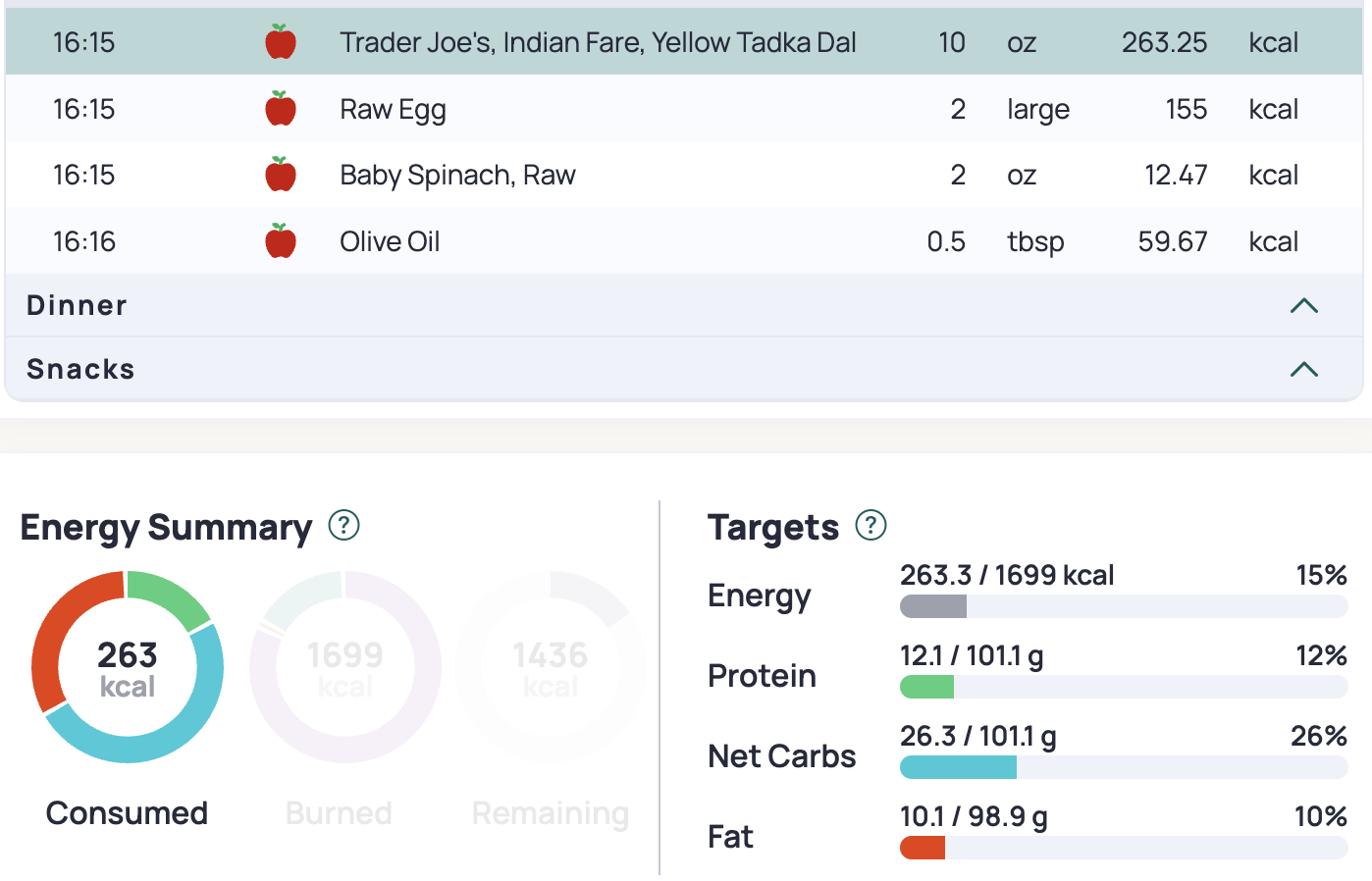
Not bad overall, except that it’s pretty low in calories (the average adult needs around 2,000 calories or more a day) and protein (most adults do well to consume about 90-100 grams per day). Moreover, it contains barely any vegetables (besides a smidge of tomatoes & onions) — and for someone like me, who tries to eat at least a serving of vegetables per meal, that’s disappointing.
With a flick of the zhuzhing wand (by adding 2 oz spinach, 2 poached eggs and 1/2 tbsp olive oil), you suddenly get this beautifully balanced, nutritious, and deeply satiating meal:

See how easy that was? You can do this with any soup like tomato, asparagus, leek & potato, spinach, butternut, carrot & ginger, etc. Even soups that already contain meat, like chicken soup, usually contain very little (because it’s expensive and food manufacturers are trying to protect their profit margin) — so check out the protein content on the label, and if it’s 15 grams or less, feel free to put an an egg or two on it.
The eggs don’t need to be poached — you can add fried eggs (yum! Apparently this is popular in Korea?), scrambled, hard-boiled, or cooked as a super-flat omelet and cut into ribbons (which I like to call “eggliatelle”).
Other proteins you can add to ready-made soups include:
- Cooked chicken, sliced or shredded (includes shredded rotisserie chicken)
- Cooked meatballs, sausage (I like chicken meatballs, but beef, lamb, or pork work too; they tend to have slightly less protein and more fat — you do you)
- Ground meat cooked in olive oil with herbs and/or spices that match the flavors of the soup (chicken, turkey, lamb. beef, pork — all work)
- Cooked shrimp (or raw shrimp that y ou cook for 1-2 minutes in the soup)
- Tofu (I cube & roast it before scattering it over soups) or tempeh (your suggestions welcome — I never cook with tempeh after too many disappointing experiences)
- Beans or lentils (not very high in protein, but every little helps when you’re zhuzhing up a vegan soup)
- Protein powder (unflavored, preferably something soup-adjacent like bone broth protein powder)
Any other suggestions? Please pop them in the comments box below!
How To Zhuzh Up Store-Bought Soup
Ingredients
- 10 oz ready-made soup can be a little more or a little less; whatever's in the packet or tin; I used Trader Joe's Yellow Tadka Dal in a pouch here
- 2 tbsp white vinegar
- 2 large eggs as fresh as possible; at room-temperature
- 2 oz baby spinach or other baby greens like kale or arugula; if using these, chop coarsely before cooking to prevent stringiness
- ½ tbsp olive oil
- a generous pinch of fresh herbs coarsely chopped; I used cilantro here, but depending on the flavor of the soup, most fresh herbs work great on soups, like parsley, dill, chives, basil, sage, green onion, etc.
Instructions
- Place a 9-inch skillet on the stove and fill it to the rim with water (using hot water speeds this up). Add the white vinegar, cover, and bring to a gentle simmer.
- While the water is heating, open the can or pouch of soup and empty it into a microwave proof bowl; it should be large enough to hold the raw spinach (which will wilt down to nothing once cooked). You can do all this in a pot on a stovetop, but microwaving is faster and requires less washing-up later.
- Dump the spinach onto the soup in the bowl. Cover and microwave on HIGH for 2 minutes. The spinach should have wilted down to a thin, dense, green layer; stir it into the hot soup with a spoon. If the spinach needs more cooking time, return for another 30-60 seconds.
- Meanwhile, poach the eggs. Place a small, fine-meshed strainer (like a tea strainer) over a cup or small bowl and crack the first egg into it. (This is to let any excess egg white strain off, reducing the formation of white wisps in the poaching water.) Gently tip the egg into the poaching water with the strainer. Repeat this with the second egg. Set a timer to 3 minutes.
- As soon as the timer rings, lift the eggs out of the water with a slotted spoon, drain off excess water for a few seconds, and place them on a clean plate or bowl.
- Now it's assembly time: Stir the soup to ensure the greens are well distributed. Season the soup (if needed) with extra salt, pepper, and perhaps a splash or cream or a squirt of lemon juice. Using a spoon, place the poached eggs on top of the soup. Drizzle with olive oil, sprinkle with herbs, and dust, if desired, with a little freshly ground black pepper. Done!