
I always feel a tad trepidacious when I post recipes from countries I’ve never visited and know very little about (but whose food I love in restaurants!). Hence the “ish” in the title.
I hope, however, that any Thai reader stumbling upon this post will see it as my feeble attempt to pay enthusiastic homage to their wonderfully fragrant, nourishing cuisine. And if they feel that this recipe could use some tweaks, I’d be grateful if they could leave their suggestions in the comments section below. I love learning from my readers.
Others may wonder: “Why is Conner posting Thai(ish) recipes, considering she’s a nutritionist specializing in Mediterranean food?” Of course, you’re right; Thailand is 4,267 miles from even the easternmost shores of the Mediterranean, and therefore its food cannot be considered “Mediterranean.”
However, traditional Thai cooking — just like that of most other ancestral cuisines — has much in common with the traditional Mediterranean way of eating, which is why I feel it can fit quite comfortably in a blog featuring more Mediterranean dishes.
Here are just some of the similarities between Thai and Mediterranean cuisines:
- A large amount of vegetables, herbs & spices with medicinal properties: Thai cuisine often incorporates a variety of fresh vegetables, herbs, and spices that provide a wide range of nutrients and health benefits. For example, ingredients like lemongrass, basil, coriander, turmeric, ginger, and galangal used in Thai dishes have antioxidant and anti-inflammatory properties and may aid digestion. Mediterranean counterparts include a wide range of vegetables and herbs like garlic, basil, oregano, dill, parsley, thyme, mint, bay leaf, rosemary, cumin, coriander, and paprika, as well as — especially in North African cuisine — ginger and turmeric.
- Seafood and a wide variety of animal proteins: Thai cuisine often includes seafood and lean proteins like chicken and tofu. These sources of protein can support healthy muscles and metabolism, while seafood like fish and shrimp contain omega-3 fatty acids, which may have cardiovascular benefits. The Mediterranean way of eating also emphasizes fish and seafood (after all, it is centered around the Mediterranean Sea whose coastline extends for 28,600 miles), and commonly eaten meats include poultry, lamb/sheep, goat, and, to a lesser extent, beef, and pork. The Mediterranean equivalent of Thailand’s tofu would be the wide range of legumes eaten in this region, ranging from chickpeas to lentils, peas, and beans.
- Variety: Both Thai and Mediterranean cuisines incorporate a wide array of plant foods that change in line with the seasons. Research has shown that eating a high variety of plant foods is associated with a healthier gut microbiome, a lower risk of certain cancers, and overall enhanced health.
- Dairy & milk: Dairy is less commonly used in Thailand, where the main “milk” comes from coconuts. While coconut milk is high in saturated fat, it can still be enjoyed in moderation. It adds richness to Thai dishes and provides essential minerals like manganese, copper, iron, magnesium, and potassium. Unlike long-chain triglycerides found in many other fats, the medium-chain triglycerides in coconut are quickly metabolized by the body and can be used as a source of energy. In the Mediterranean, dairy is consumed in moderate amounts, mostly in the form of yogurt, kefir, and cheese.
- Healthy Cooking Methods: Both cuisines involve stir-frying/sauteeing, steaming, low-temperature braising, and grilling, which are generally considered to be healthier cooking methods compared to deep-frying or industrial food processing.
So, you see — while you might not expect to be served Thai curry at a traditional restaurant in Seville, Beirut, or Marrakesh, it is actually quite “Mediterranean” in composition, combining high-quality protein, healthy fat, fiber-rich vegetables and flavorful aromatics brimming with antioxidant and anti-inflammatory properties.
And just like its Mediterranean counterpart, Thai cuisine is highly versatile. Therefore, feel free to vary the proteins (instead of chicken, try shrimp, squid, scallops, salmon, pork, beef, hard-boiled eggs, tofu, or edamame beans — or a combination of these), vegetables (in addition — or as alternatives to — the above-mentioned vegetables, why not try eggplant, asparagus, sugar snap or snow peas, broccoli(ni), onions, tomatoes or zucchini?) and garnishes (such as sesame seeds, cilantro, green onions — the more, the merrier).
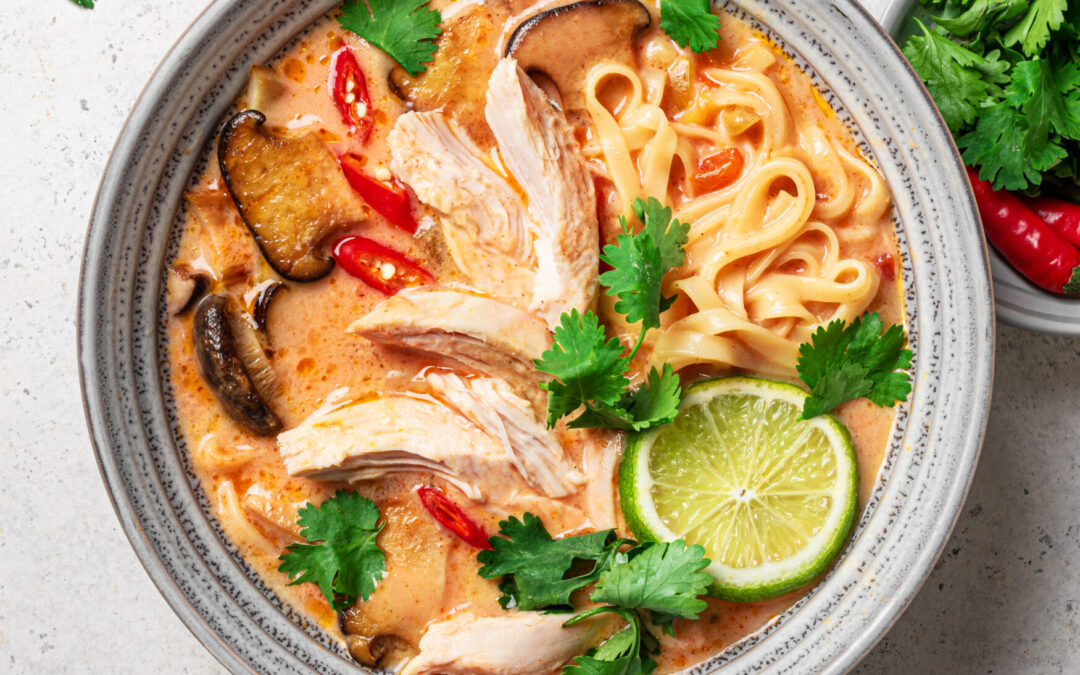
Thai-ish Weeknight Curry
Ingredients
- 1 tbsp olive oil or coconut oil
- 1 large yellow onion diced
- 14 oz coconut milk full-fat
- 2 cups chicken bone broth or vegetable broth; add more if desired -- some like their curry thick, others like it soupy
- 2 tbsp fish sauce my favorite is Red Boat; click here for a list of veg(etari)an fish sauce alternatives
- 1-2 tbsp massaman curry paste mild but packed with fragrant flavor; my favorite brand is Mae Ploy – available at Asian supermarkets or online
- 1 tbsp red curry paste optional (if you like a bit of spice); I like Mae Ploy's red curry paste
- 8 oz sweet potato or 2 med-lge carrots; peeled & cut into ¾-inch cubes
- 1½ lb shrimp, shrimp, peeled, tail-on. ALTERNATIVELY: 1½ lbs boneless, skinless chicken thigh or breast crosswise into ¼-inch slices OR 1½ lbs raw, cubed salmon OR 1 lb cubed tofu (I recommend Trader Joe's high-protein tofu)
- 1 large red bell pepper seeded and cut into ¾-inch dice
- 8 oz cremini mushrooms sliced
- 1 cup snow peas or sugar snap peas
- 1 small can bamboo shoots drained
- 1 tbsp tomato paste or fresh lime juice
- 6 oz rice noodles optional; cooked according to package instructions
- ½ cup Thai basil or cilantro coarsely chopped; save a few leaves for garnish
- ¼ cup roasted peanuts coarsely chopped
- 1 lime thinly sliced, as garnish
- 2 tsp sesame seeds as garnish
Instructions
- In a large pot with a heavy bottom, warm the oil and saute the onion for 5-6 minutes until it starts to turn translucent. Add the curry paste(s) and mix into the onions.
- Add the coconut milk, chicken bone broth, and fish sauce and bring to a boil over medium-high heat. Add sweet potato cubes and simmer, covered, until almost soft, 6-8 minutes. (To speed up the dish, you can omit the sweet potato.)
- Add pepper, mushrooms and snow peas/sugar snap peas to the pot, cover and simmer, stirring occasionally, until tender (about 5 minutes). Now add your protein of choice and cook for another 2-3 minutes (shrimp) or 4-5 minutes (thinly sliced chicken) until cooked through.
- Stir in tomato paste or lime juice (whichever using) and chopped herbs. Season with salt or fish sauce as desired. Add cooked rice noodles (if using); these should ideally be hot (if not, reheat briefly in the microwave or in a bowl of just-boiled water).
- Ladle into bowls and garnish each bowl with lime slices, chopped peanuts, Thai basil and/or cilantro.
- Stored in an airtight container this keeps for 4-5 days in the fridge; freezes well. Well suited for meal prep.
We made this dish and really enjoyed it. The recipe doesn’t say when to add the bamboo shoots, but we guessed peas and herbs and it worked out fine.